India's MSME Law Gets New Teeth By Rajiv K Chawla Chairman, IamSMEofIndia
Dear friends,
Sometimes, the importance of a reform is best understood not by how loudly it is announced, but by how long those affected have waited for it.
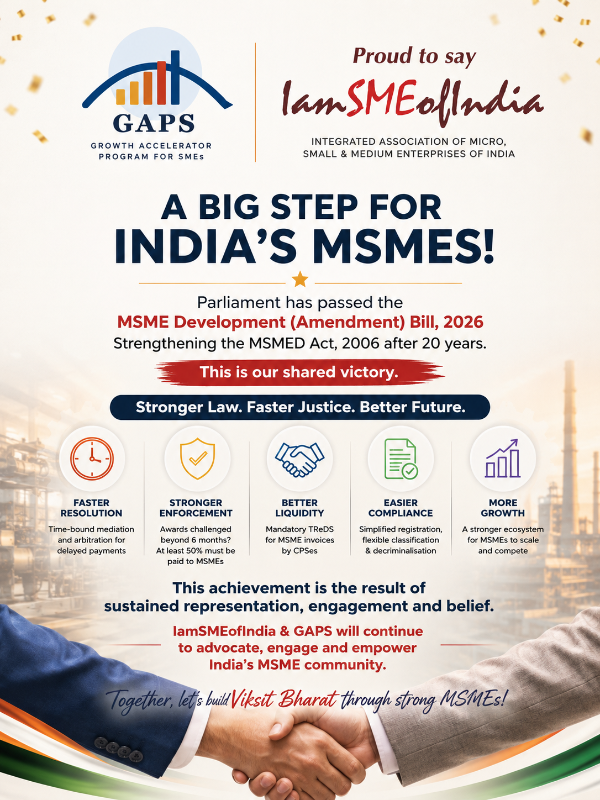
Twenty years after the Micro, Small and Medium Enterprises Development Act, 2006 laid an important statutory foundation for India’s MSME sector, Parliament has now passed the Micro, Small and Medium Enterprises Development (Amendment) Bill, 2026.
For millions of entrepreneurs across India, this is much more than another legislative amendment.
It is an acknowledgement of problems that MSMEs have lived with every day: delayed payments, prolonged dispute resolution, locked-up working capital, procedural complexity and the enormous imbalance in negotiating power between a small supplier and a large buyer.
For us at IamSMEofIndia, the passage of this Bill is also a moment of gratitude and quiet satisfaction.
For years, we have been at the forefront of representing the concerns of Micro, Small and Medium Enterprises before policymakers and other stakeholders. We have consistently advocated that the MSMED Act, 2006, while visionary for its time, needed strengthening to meet the realities of a vastly transformed Indian economy.
We have repeatedly emphasised a simple principle: A law protecting MSMEs is meaningful only when an MSME can actually enforce the protection given to it.
That is why the 2026 Amendment is significant. From Rights on Paper to Rights That Can Be Enforced
Perhaps the most important area addressed by the Bill is delayed payments.
The MSMED Act already created strong payment protections for Micro and Small Enterprises. Yet, in practice, an enterprise could have the law on its side and still find itself waiting months—or sometimes much longer, to recover money legitimately due to it.
And for an MSME, delayed payment is not merely an accounting entry.
It is working capital.
It is wages.
It is GST already paid.
It is raw material for the next order.
It is interest on bank borrowings.
It is the ability to invest, hire and grow.
When a large organisation delays payment to a small supplier, the MSME effectively becomes an involuntary financier of the buyer.
That cannot be the foundation of a healthy industrial ecosystem.
The new Bill seeks to make the dispute-resolution mechanism far more time-bound. Mediation is proposed to be completed within 90 days from the first appearance. Where mediation fails, the matter is to be referred for arbitration within 30 days, and the arbitral award is to be made within 90 days from completion of pleadings.
Even more significantly, where an award is challenged and proceedings continue beyond six months, the court will be required to order payment of at least 50% of the awarded amount to the MSME supplier.
This could fundamentally change the economics of delaying an MSME’s legitimate dues through prolonged litigation.
TReDS: Turning Receivables into Liquidity Another important reform is the requirement that Central Public Sector Enterprises settle invoices arising from procurement from MSMEs through RBI-regulated Trade Receivables Discounting System platforms.
This can have a direct bearing on working-capital availability.
TReDS allows MSMEs to convert accepted invoices into liquidity through competitive financing rather than waiting indefinitely for the buyer’s normal payment cycle.
The wider adoption of TReDS can bring greater transparency, traceability and financial discipline into the procurement ecosystem.
It can also reduce one of the biggest hidden costs confronting Indian MSMEs—the cost of financing somebody else’s balance sheet.
A More Contemporary MSME Framework The Amendment goes beyond delayed payments.
The framework for MSME classification is being made more flexible by enabling the Central Government to prescribe investment and turnover thresholds through notification.
Registration is being simplified through digital platforms and made voluntary across categories.
The legislation also moves towards decriminalisation of certain procedural defaults, replacing criminal-style consequences with warnings and graded monetary penalties.
States are expected to have greater flexibility in strengthening Micro and Small Enterprises Facilitation Council mechanisms.
Taken together, these provisions reflect an important philosophical shift—from excessive procedural regulation towards facilitation, faster resolution and enforceable commercial rights.
A Moment for Gratitude At IamSMEofIndia, we welcome this development with gratitude.
We acknowledge the Government of India, the Ministry of MSME, Members of Parliament, officials, institutions, industry organisations and every stakeholder who has contributed to bringing MSME concerns to the policy table.
Public policy is rarely changed by one representation or one meeting. Meaningful reform is usually the result of sustained engagement over years, industry communicating its ground realities and government progressively responding to them.
IamSMEofIndia has been privileged to participate in this process.
We have consistently carried the voice of entrepreneurs to policymakers, not merely pointing out problems, but attempting to suggest practical solutions emerging from the factory floor, the balance sheet and the everyday experience of running an enterprise.
Seeing some of these concerns finding expression in legislation after two decades is therefore deeply encouraging.
But this is not the end of the journey.
The Next Challenge Is Implementation Good legislation can create the framework. Good implementation creates the outcome.
If mediation is required to finish within 90 days, institutional capacity must exist to make those 90 days meaningful.
If arbitration is to be accelerated, Facilitation Councils need adequate infrastructure, people and technology.
If TReDS is to unlock liquidity, invoice acceptance and buyer participation must happen promptly.
And while public-sector payment discipline is being strengthened, India must continue the conversation on delayed payments across the entire corporate ecosystem.
We must also remember an important technical distinction: some of the strongest delayed-payment provisions of the MSMED framework specifically protect Micro and Small Enterprises, rather than every enterprise falling within the broader MSME classification. This is another area that deserves continued policy examination.
Our Engagement Will Continue For IamSMEofIndia, advocacy has never meant confrontation. It means constructive engagement.
We shall continue to engage with the Ministry of MSME, Central and State Governments, policymakers, financial institutions, public-sector enterprises, large corporations and other stakeholders on issues affecting India’s MSMEs.
There is much more to be done, on access to affordable finance, technology adoption, competitiveness, sustainability, exports, skilling, ease of doing business, delayed payments and creating an ecosystem in which small enterprises can become large enterprises.
We now look forward to Presidential assent and the subsequent notification and implementation of the Amendment, which we hope will follow soon.
But today is a moment worth acknowledging.
Twenty years after the MSMED Act, 2006, Parliament has approved an important strengthening of India’s MSME framework.
For those of us who have spent years asking for stronger mechanisms and more effective protection for small businesses, it reinforces a valuable lesson:
Persistent representation matters. Constructive engagement matters. And when policymakers and industry listen to each other, reform happens.
India cannot realise its ambition of becoming a developed economy without creating stronger enterprises at its foundation.
MSMEs do not merely need protection. They need the freedom, liquidity and confidence to grow.
This Amendment is an important step in that direction.
Rajiv K Chawla
Chairman IamSMEofIndia
Integrated Association of Micro, Small & Medium Enterprises of India
Integrated Association of Micro Small & Medium Enterprises of India
(Not-for-Profit Institution for Growth & Development of MSMEs) IamSMEofIndia, 135, Sector 59, Phase-II,
Faridabad- 121004, Haryana, India
Ph: +91-9711101666 (EVP) ; +91-9711123111 (Executive Secretary)
E-mail: info@iamsmeofindia.com ; Website: www.iamsmeofindia.com CIN NO : U73100HR2009NPL039044
IamSMEofIndia is India's first "GOLD GRADE" National Level Business Member Organisation Accredited by NABET-QCI
Adjudged No.1 at the National Level as "The Most Responsible Business Member Organisation"
Integrated Association of Micro Small & Medium Enterprises of India
(Not-for-Profit Institution for Growth & Development of MSMEs)
IamSMEofIndia, 135, Sector 59, Phase-II,
Faridabad- 121004, Haryana, India
Ph: +91-9711101666 (EVP) ; +91-9711123111 (Executive Secretary)
E-mail: info@iamsmeofindia.com ; Website: www.iamsmeofindia.com
CIN NO : U73100HR2009NPL039044
IamSMEofIndia is India’s first “GOLD GRADE” National Level Business Member Organisation Accredited by NABET-QCI
Adjudged No.1 at the National Level as “The Most Responsible Business Member Organisation”
All Trademarks are Property of their respective owners
Disclaimer: The contents of this email are confidential and are intended for the addressee/s only. If any error has misdirected this e-mail, you must not use, disclose, distribute, copy, print, or rely on this e-mail.. If you are not the intended recipient please advise by return email. We do not warrant that this email is free of a virus or any other defect. Care has been taken to provide authentic information, but it is advisable to confirm/verify with a qualified legal practitioner before implementing any suggestions. You are receiving this email as present or potential Member/Associate of Integrated Association of Micro, Small & Medium Enterprises of India. If you do not wish to receive these e-mails, please reply and write “UNSUBSCRIBE” in the subject field.
Our mailing address is:
Integrated Association of Micro, Small & Medium Enterprises of India